

June is the month where HPE organizes its biggest customer and partner event of the year: HPE Discover in Las Vegas… Here you can see, feel ans hear about all the latest HPE solutions and meet with the people who makes this all happen in 1 place.
Not going to bother you too much with all the AI announcements, my focus was more on what my customers are interested in, and that is a solution for the current challenges in the hypervisor space. VM Essentials is a great alternative there, with actually several customers already in production, but everyone keeps on asking me what’s next.
Well, next is there! And even more as expected and teased… BIG news!
Welcome HPE Morpheus Advanced!
So far HPE Morpheus VM Essentials, how it is called officially, is actually HPE Morpheus Enterprise software, but with a lot of enterprise stuff disabled. For instance don’t look for automation with Ansible, Chef, Puppet, Terraform and so on in VM Essentials, or Service Provider features like Multi Tenancy, because it is not there… It is there but you don’t see it due to the VM Essentials license that you are using. Nice to know is that you can unlock all these enterprise features just by copy/pasting the enterprise upgrade license…
However! The step between the 2 was quite big, also in price, but I had quite some customers who were asking container/Kubernetes features, which was so far only available in the Enterprise edition of HPE Morpheus.
Enter HPE Morpheus Advanced!
HPE listened very well to what the customers are looking for (including mine), since they announced an in-between version of HPE Morpheus: more than Essentials, less than Enterprise. Spot on!
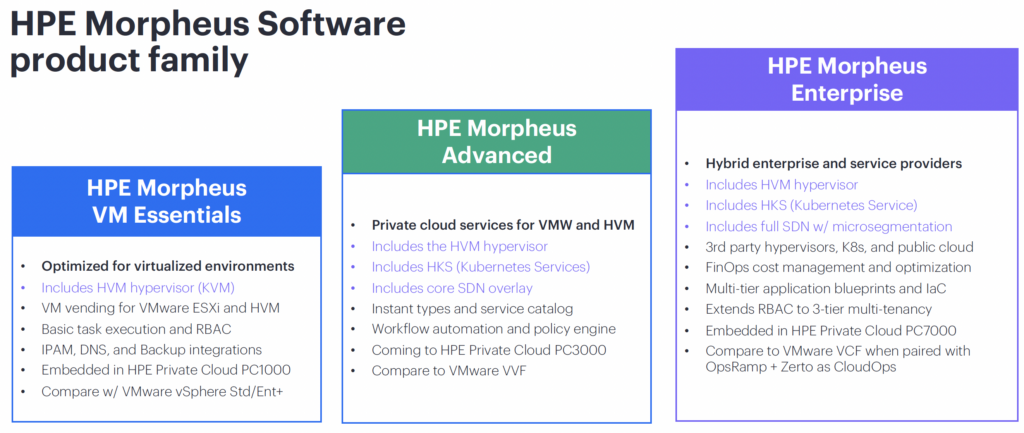
Positioning is quite clear :
- Looking for a solution to run and manage VM’s easily? Go VM Essentials edition.
- Looking for VM’s and Containers in combination with some SDN (Software Defined Networking)? Go Advanced!
- Want all the whistles and bells? Go Enterprise!
All this will be available now with the newly released version 9.0.
Further 9.0 updates.
The portfolio extension was not the only update for the HPE Morpheus software stack. A lot of long-awaited features and functions are (finally) there, making it now THE VMware alternative on the market for sure.
Simplified installer experience
HPE listens to the feedback from the early adopters (like me). One of the feedbacks that comes most is the installation experience. Despite the availability of several video’s (look at my site!) and an extended documentation set, people still love the ease of deployment of let’s say VMware.
I will have to redo my video on the deployment of the VM Essentials Manager, since with version 9.0 now that experience got 100 times better (not that it was bad but…) with a GUI based deployment tool that asks a few simple questions, and it will deploy the Manager VM completely for you. Kudo’s to the Morpheus developers!
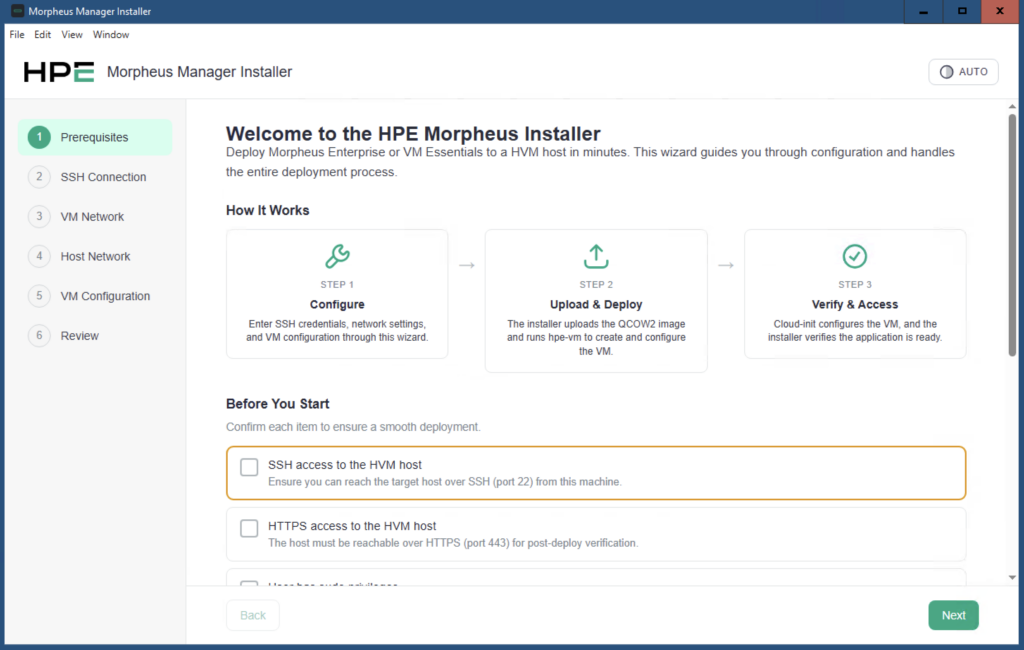
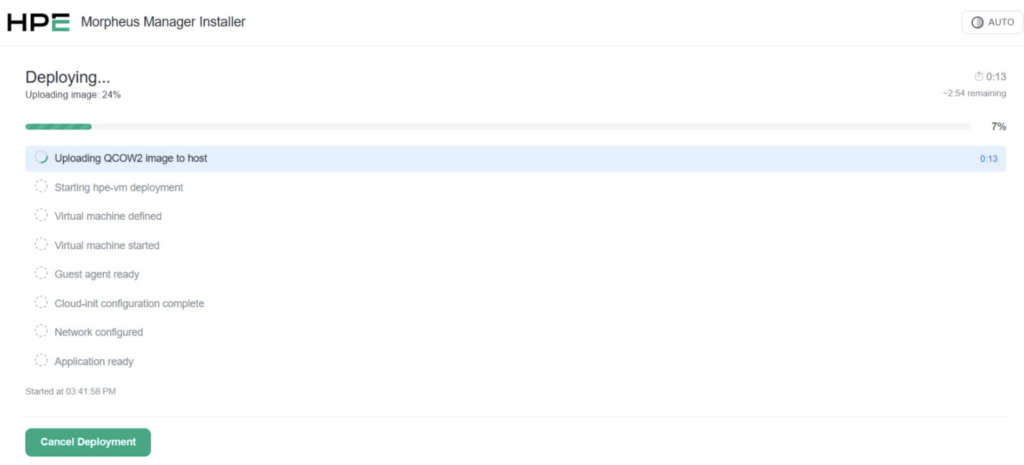
Some pictures from the installation flow, video will be posted soon!
2-node cluster support with GFS2
A big thing for a lot of customers who wants to make the switch from their current hypervisor twards VM Essentials will be the replacement of Pacemaker Cluster Service? I see you think what? What is PCS?
Well if you attended one of my trainings then you know it is quite important in the clustering mechanism used onder the hood to guarantee quorum and uptime. And the use of PCS is responsible for the 3-node requirement when using GFS2 as filesystem to store your VM’s on a SAN-based storage arry, comparable to VMFS within VMware.
Well that 3-node requirement is gone now with the replacement of PCS with an HPE-own solution where the Morpheus Agent will be used in the quorum process, and so 2-node clusters will be supported from now. Important to know is that a quorum witness services needs to run somewhere in your environment to avoid split-brain situations, quite common in cluster setups with 2 nodes…
For the techies: this will involve an upgrade from the cluster layout which is today version 1.2 to a new version 1.3. This cluster upgrade process can be done completely online by using a rolling upgrade mechanism.
More details in a dedicated post where i will dive deeper into this.
Morpheus Central
The feature I was waiting for the most maybe is Morpheus Central. It delivers cloud connected controls to simplify multi-site and multi-instance management
Delivered through the HPE GreenLake Cloud Platform it gives you a SaaS-like lifecycle management of all your Morpheus deployments, independent of which version (Essentials, Advanced, Enterprise) you are running. With the multi-site data telemetry that is send to a central dashboard it gives you a centralized FinOps cost and consumption insights and visibility into hybrid cloud usage and integrations.
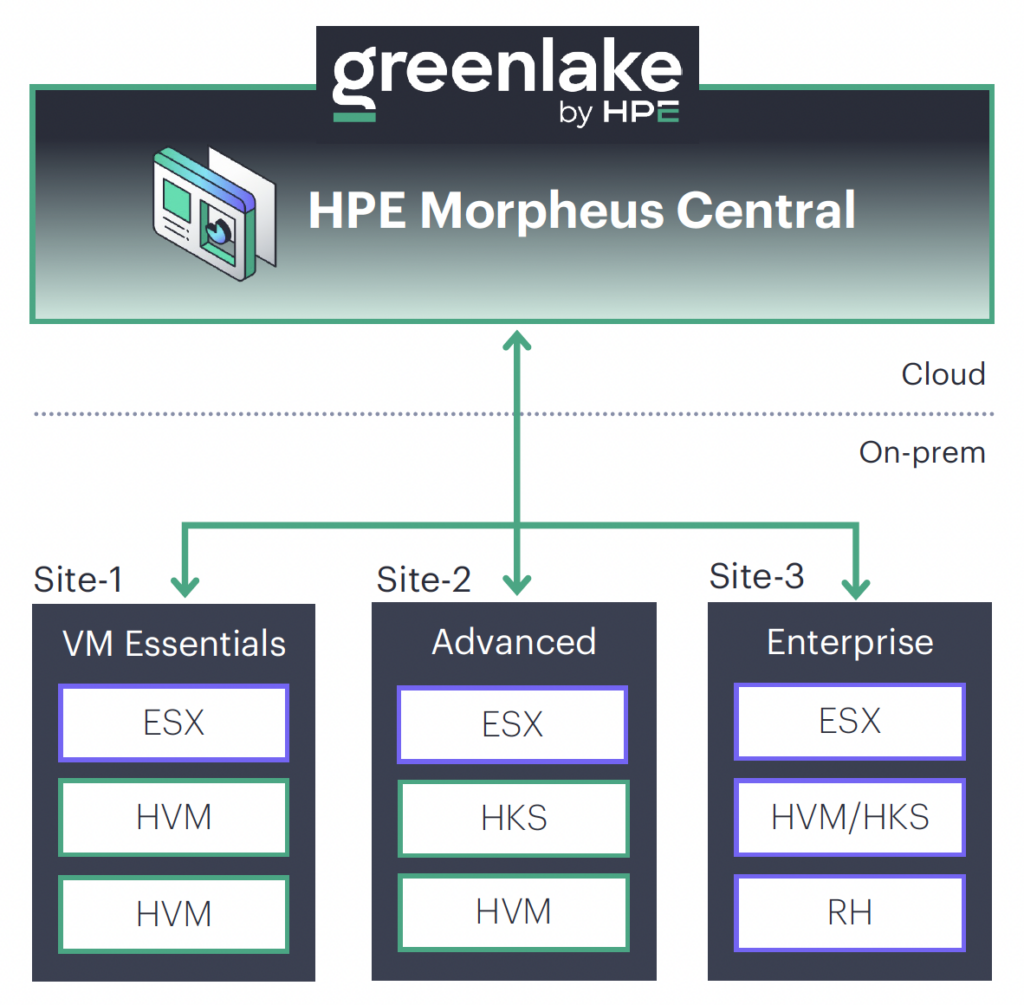
Once it is active, I will connect my environment to Central and will create a dedicated post and video on Central with a technical deep dive. Stay tuned!
Stretched Cluster support
Another long-awaited feature (definitely in Europe) is the support for stretched clusters, aka 2 datacenters with sync replication of all data, and automatic failover. It worked already before with Alletra MP with Peer Persistence, but the compute cluster had to be 1 cluster without data locality across sites. This is solved now with the new version 9.0 and official stretched cluster support.
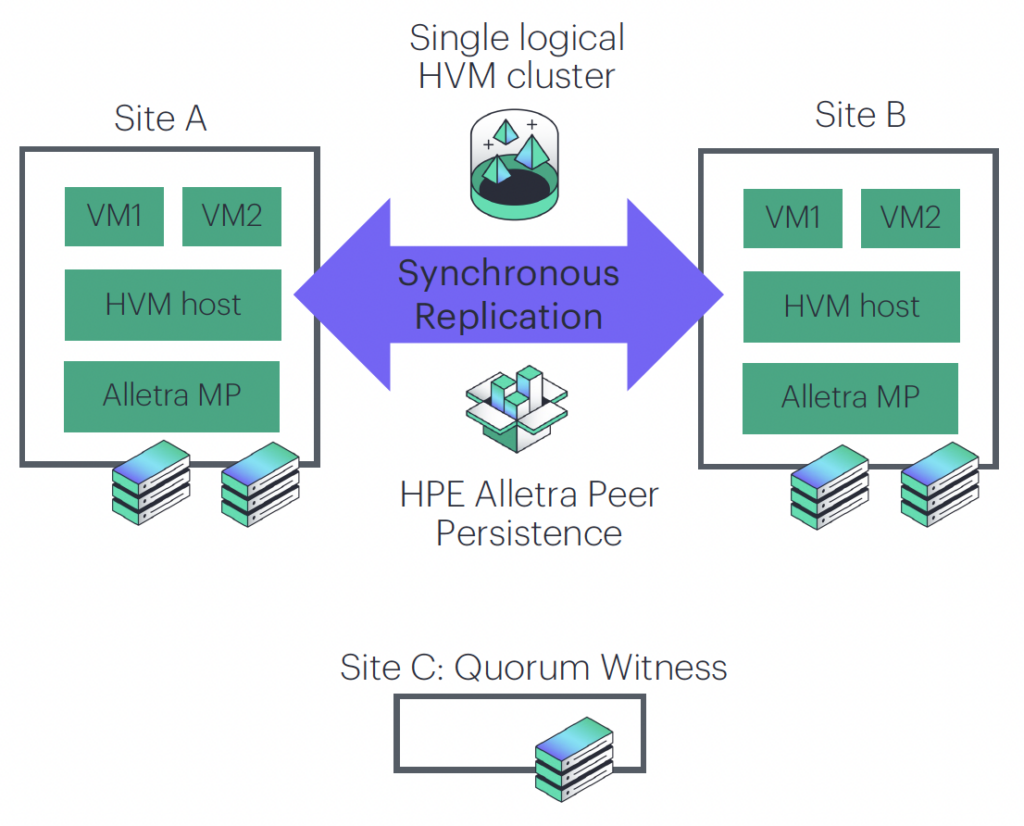
Very similar to other deployments like with VMware in combination with Alletra MP Peer Persistence, you will get now the same zero disruption experience during compute, storage or site failures when using HVM as hypervisor and VM Essentials/Advanced/Enterprise in your control plane. The Quorum Witness integration will provide a storage-native metro protection with transparent failover and business continuity.
SDN for HVM: Micro-segmentation for Zero Trust
The current version of HVM and VM Essentials supports already some kind of SDN (Software Defined Networking), but was relying on the features and functions of the Aruba stack, which meaned that you needed an Aruba CX 10000 switch in your environment. SDN relying on actual hardware… Bwa…
Now there is true SDN by using Contrail technology. This is a software-defined networking (SDN) and network automation platform developed by Juniper Networks. It simplifies and automates the creation, management, and security of virtual networks across private, public, and hybrid cloud environments.
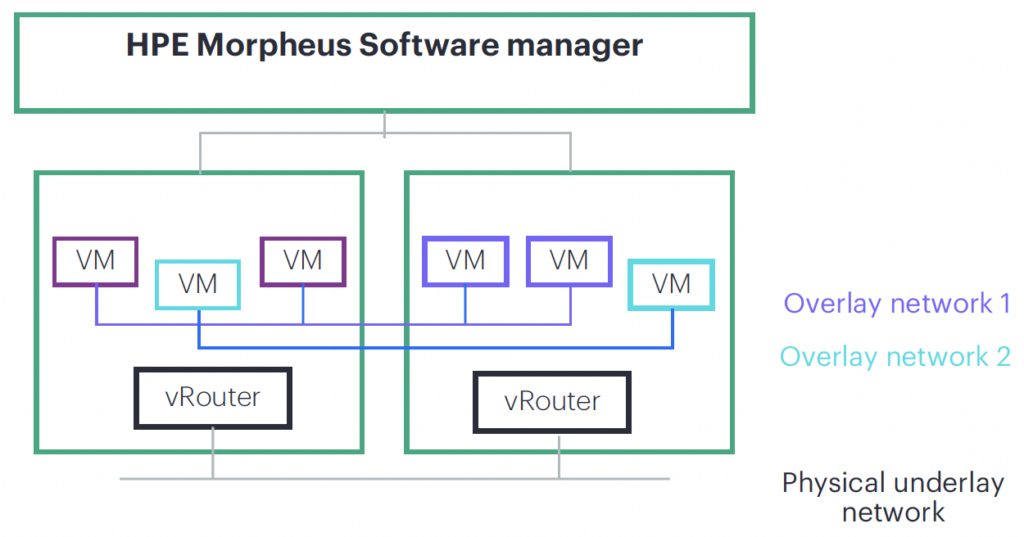
Since it is running as containers on the HVM hosts (that is why we needed HKS support in Advanced and not only Enterprise!) you will get all the sweet stuff in the Advanced version. For the ultimate micro segmentation and security features you will still need the Enterprise edition of HPE Morpheus software.
Some more sweet updates under the hood
Maybe not that big as announcement but HVM as hypervisor got some important updates as well to compare better with the big hypervisors out there…
Version 9.0 supports memory overcommitment now to maximize your memory investments, with the prices today a nice welcome.
So far you could not overprovision virtual machine memory, this is fixed now and gives you more headroom there.
Another new feature is Shared vDisk support. With version 9.0 on you can present and share vDisks to multiple virtual machines at the same time, and so enables application and database clustering.
Third one is vTPM/SecureBoot support for guest OS encryption. This is ideal for virtual machines leveraging guest OS encryption e.g. with Bitlocker. Enhancements enable support for cross migration within a cluster. It will allow as well for backup and recovery without prompting for an encryption key.
And there is SR-IOV support that allows sharing of a PCIe bus amongst virtual machines for improved performance.
All details can be found in the 9.0 Release Notes on the HPE Support website. All links can be found on my website www.hpepedia.com !
Want more information on all this, or even better a demo, workshop or training? Just contact us!